You want another plant. Your floor says otherwise.
Maybe the windowsill is full. The coffee table already has enough on it. There is no room for another plant stand, and giving up part of the walkway is not an option.
That doesn’t necessarily mean you’re out of space.
It may mean you’re only looking at one level of the room.
In a small apartment, some of the most useful growing space can be above furniture, on a shelf, near a window, along a wall or in a corner you’ve stopped noticing.
Before buying another plant, start with the space you already have.
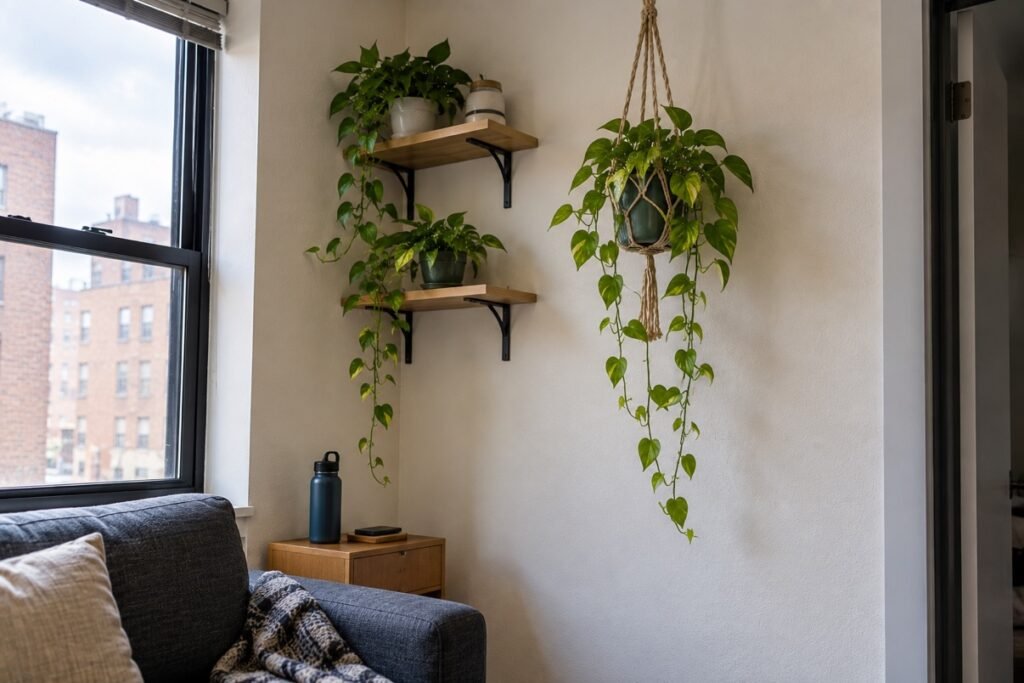
Before You Buy Another Plant, Look Up
When floor space becomes limited, the room doesn’t suddenly end.
There is still space above a cabinet. There may be room on an existing shelf. A wall may support an appropriate mounted setup. A hanging planter may work in the right location. Even a narrow corner can sometimes hold several growing levels without taking over the room.
The goal isn’t to cover every empty surface with plants.
It’s to notice possibilities you may have been ignoring.
Sometimes the Problem Is How We Look at the Room
When we think a room is full, we usually mean the surfaces we use every day are full.
The floor has furniture. The table has a purpose. The windowsill may already be occupied.
But those are not the only dimensions of the room.
Look at the space between the top of a cabinet and the ceiling. Look beside the window instead of only at the sill. Notice the blank section of wall above furniture or the corner where nothing currently happens.
Not every one of those places will work for a plant. Light, support, water and access still have to make sense.
The point is not to declare every empty spot usable.
It is to start seeing the room differently enough to ask the next question: could something grow here?
Start With the Space, Not the Plant
It is easy to do this backward.
You see a plant you like, bring it home and then walk around trying to find somewhere to put it.
Try reversing the process.
First, find a possible growing space.
Then ask:
- How much light reaches it?
- Can I water a plant there without creating a mess?
- Can the surface or support safely handle the weight?
- Can I reach the plant easily enough to care for it?
- What kind of setup actually fits there?
Only after answering those questions should the plant enter the decision.
That shift matters because the right plant isn’t just one you like. It’s about choosing the right plant for your space, one that makes sense for the conditions you can realistically provide.
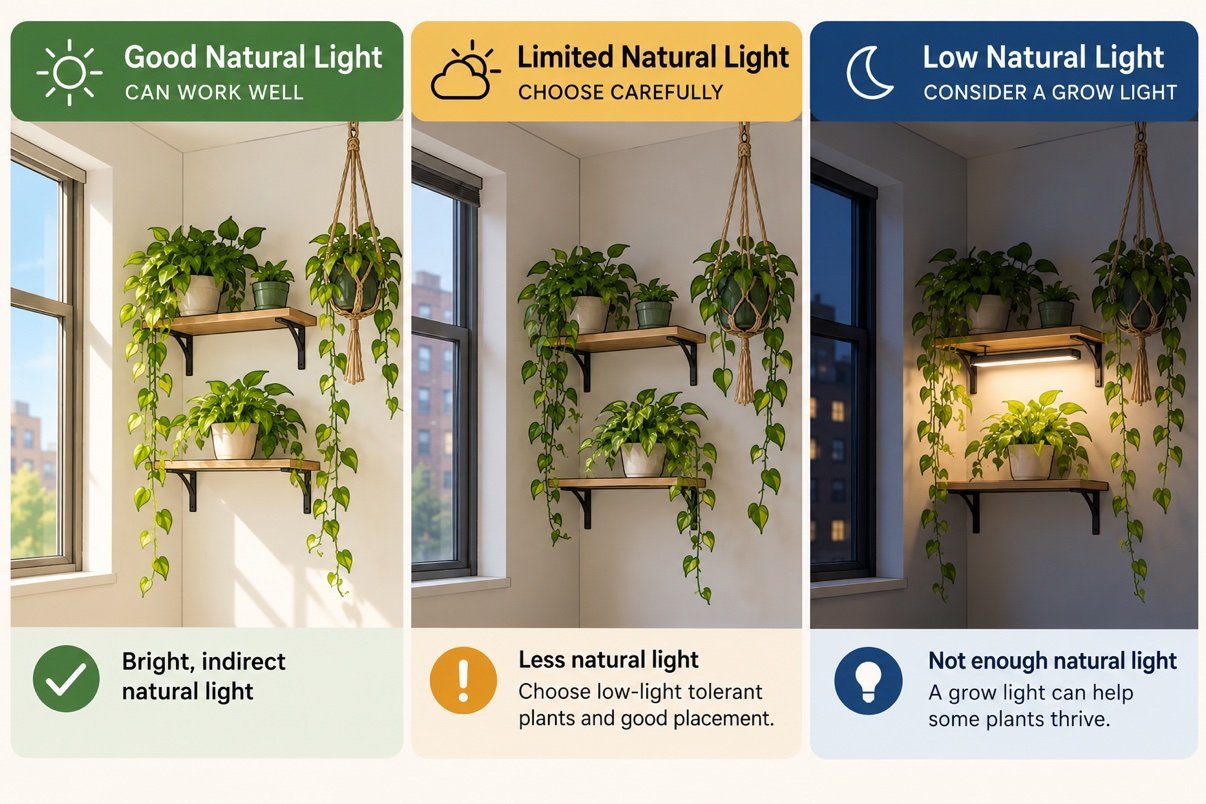
Check the Light Before You Choose the Spot
An empty wall is not automatically plant space.
Two spots only a few feet apart can receive very different amounts of natural light depending on the window, direction, obstructions and distance from the light source.
So before installing a shelf or hanging a planter, watch the space.
Where does daylight actually reach?
How does that change during the day?
A location with suitable natural light may already give you what you need.
A location with less light may call for a plant better suited to those conditions.
If you’re unsure about a particular spot, check how much light that spot actually gets.
And if natural light simply doesn’t reach a useful space, that doesn’t automatically mean the space is unusable. Supplemental artificial light can sometimes open up another possibility.
This doesn’t mean putting any lamp above a plant and hoping for the best. The type of light, its intensity, placement and duration all matter.
You don’t need to solve that part yet. We’ll cover how grow lights work, what matters and when they make sense in a separate guide.
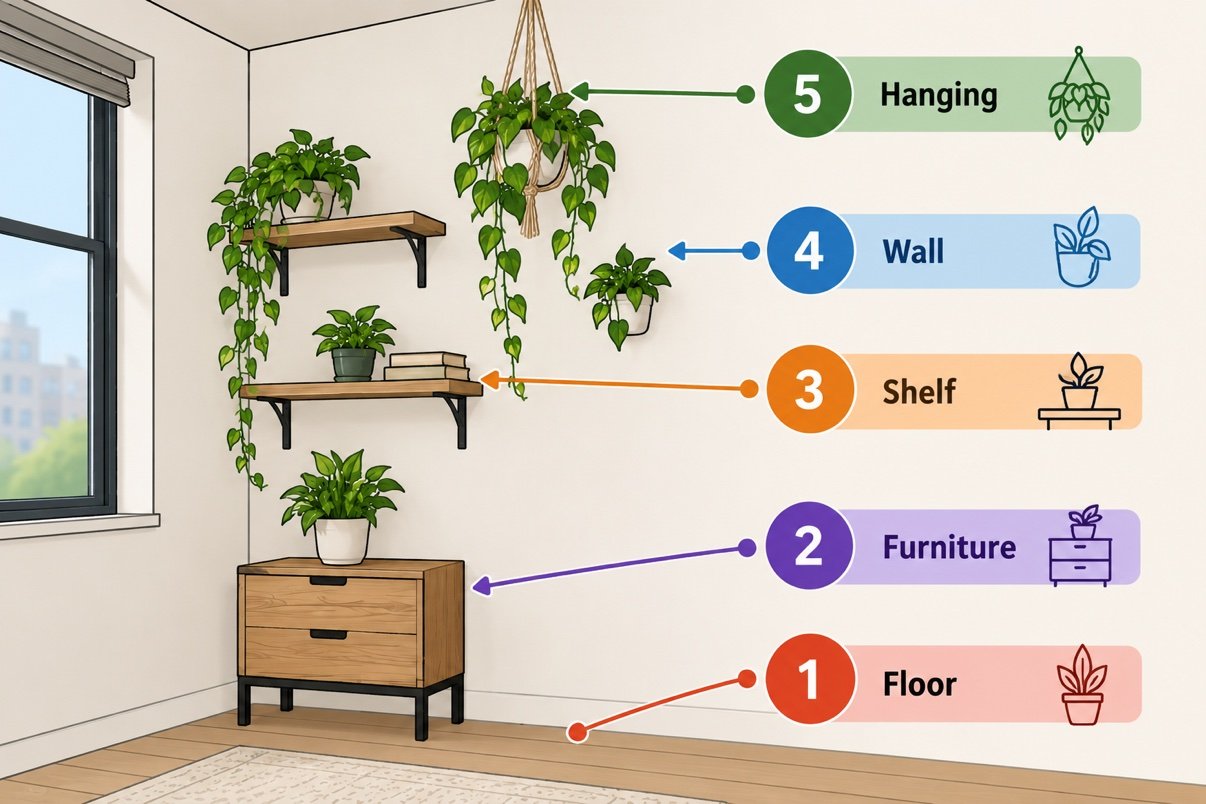
7 Places You May Not Be Using Yet
Once you stop looking only at the floor, the apartment starts to look different.
1. Above Existing Furniture
A dresser, cabinet, console or other sturdy piece of furniture may already create a useful level above the floor.
The important question isn’t simply whether a pot fits there. Consider the light, stability, watering and whether you can comfortably reach the plant.
2. Existing Shelves
You may not need a new plant stand at all.
An existing shelf can sometimes share space with a plant, provided the shelf can safely support the total weight and the plant receives suitable light. The same principle applies in kitchens: you can add plants to a small kitchen without losing counter space.
Leave enough room to water, inspect and maintain it without turning routine care into a balancing act.
3. A Narrow Vertical Shelf
When horizontal space is scarce, a narrow shelving unit can create several levels within a relatively small footprint.
This can work especially well in an overlooked corner or beside existing furniture, as long as the location provides appropriate conditions for the plants you choose.
4. Window-Adjacent Space
The windowsill isn’t the only space connected to a window.
Depending on the room, there may be usable space beside the window, slightly below it or on nearby shelving.
The important part is to evaluate the actual light rather than assuming that anything near a window receives the same conditions.
5. Hanging Space
A hanging planter can move a plant completely off the floor and furniture.
But hanging introduces another question: support.
The mounting system needs to be appropriate for the surface and for the complete load, including the container, growing medium, plant, water and future growth.
If you don’t know what a ceiling or mounting point can safely support, verify it before hanging anything.
6. Wall-Mounted Space
A properly installed wall shelf or planter can turn an unused vertical surface into growing space.
Again, the empty wall is only the beginning of the evaluation.
Light, mounting, weight, watering and access still matter.
7. An Overlooked Corner
Corners often disappear from our mental map of a room.
A corner may accommodate a narrow shelf, a single elevated plant or a combination of levels without requiring plants to spread across the rest of the apartment.
The goal isn’t to fill the corner.
It is to determine whether that particular space can support something growing there.
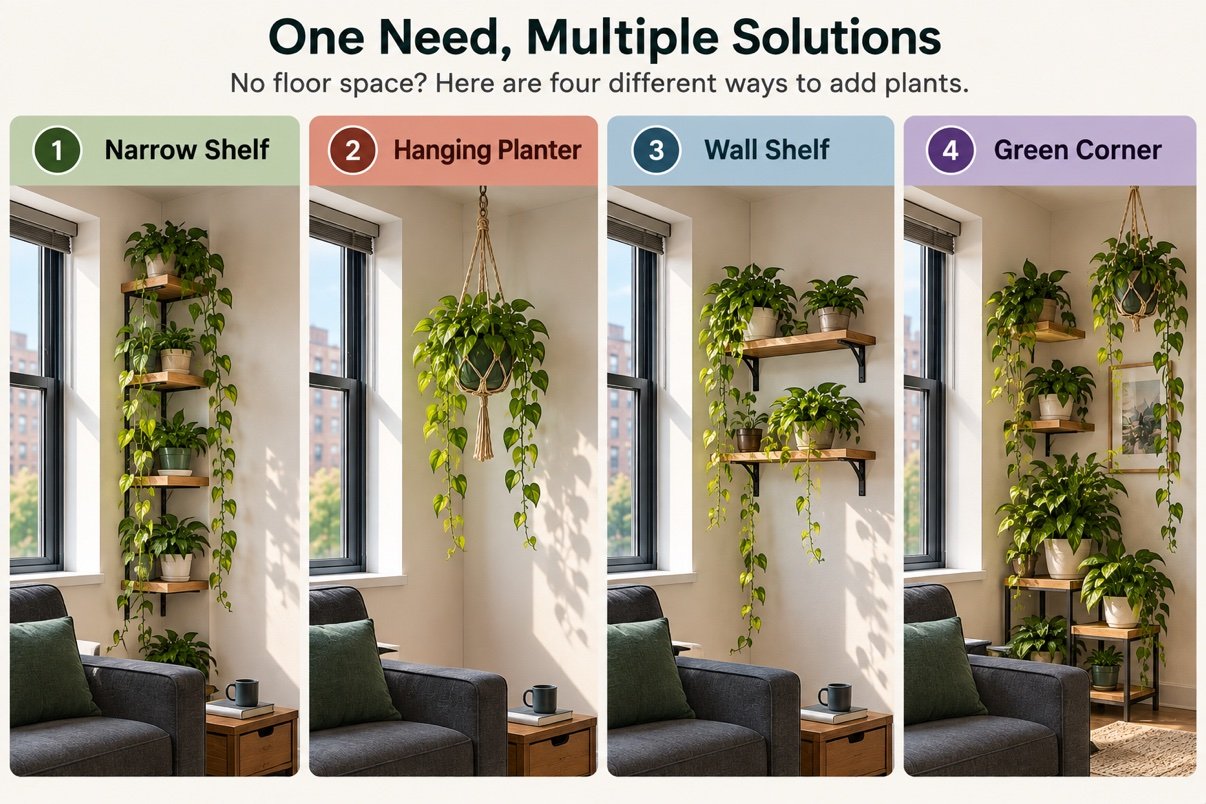
Choose the Right Vertical Setup
Once you’ve identified a possible location, the structure should follow the space.
A narrow shelf may make sense where you have a small amount of floor area but useful height. If shelving makes the most sense for your space, a simple setup can create several growing levels without spreading plants across the room. Our three-level plant shelf shows one way to approach it.
A hanging planter may work where keeping the floor completely clear matters.
A wall shelf may be appropriate where the wall, mounting method and light conditions support it.
A green corner can combine a few levels when the room naturally provides enough space for that arrangement.
None of these is the better or more advanced solution.
The right setup is the one that fits the space you actually have and still allows you to care for the plant properly.
Think About Water Before You Put Plants Above Furniture
Vertical gardening changes where excess water can go.
A plant above a desk, cabinet, sofa or finished floor needs more thought than a pot placed somewhere that can tolerate occasional moisture.
Containers should allow appropriate drainage, but drainage also has to be managed.
Consider where excess water will collect, how you’ll empty it and whether nearby surfaces need protection.
A tray can help in some setups, but it doesn’t replace careful watering or proper drainage.
And avoid relying on a universal watering schedule.
How often a plant needs water depends on factors such as the plant itself, light, temperature, container and growing conditions.
Think About Weight Too
A small pot can become considerably heavier once it contains growing medium, a plant and water.
That matters on shelves, and it matters even more when something is mounted to a wall or suspended overhead.
Think about the complete wet weight of the setup, not just the empty container.
As the plant grows, that load can change too.
For mounted or hanging systems, follow the requirements of the specific hardware and mounting surface rather than assuming that one type of hook or fastener works everywhere.
Don’t Make Your Plants Hard to Care For
A vertical setup can save space and still be a bad setup if routine care becomes difficult.
Can you reach the soil?
Can you remove or rotate the pot if needed?
Can you inspect the leaves?
Can you water without climbing awkwardly over furniture?
Can you deal with excess water?
If caring for the plant becomes inconvenient every time, the location probably needs to be reconsidered.
Saving space shouldn’t mean making the plant difficult to care for.
Start With One Vertical Zone
You don’t need to redesign the apartment.
Choose one area.
Maybe it’s the space above a cabinet.
Maybe it’s one blank section of wall.
Maybe it’s the corner beside a window that you’ve walked past every day without considering it growing space.
Observe the light.
Think about water.
Think about weight.
Think about how you’ll reach the plant.
Then decide what kind of structure, if any, makes sense there.
One well-chosen plant in a workable location can teach you more about your space than filling the room all at once.
Your Vertical-Space Checklist
Before adding a plant above floor level, ask:
- Does this spot receive suitable light, or will I need another lighting solution?
- Can the structure safely support the complete load?
- Where will excess water go?
- Can I reach the plant comfortably?
- Will the plant have enough room as it grows?
- Does this setup fit the way I actually use the room?
If several of those answers are unclear, solve those questions before adding the plant.
Your Apartment May Have More Growing Space Than You Think
Running out of floor space doesn’t always mean running out of growing space.
Sometimes the next opportunity is already in the room: above something, beside something, attached appropriately to a wall, hanging in the right place or waiting in a corner you’ve overlooked.
You don’t need to use every option.
And you don’t need to turn the apartment into a jungle.
Start with the space.
Understand the light.
Find the solution.
Choose the plant.
Then give it a little life.
Your space may already be enough.
Start With One Space Today
Look around your apartment and choose one area you’ve been overlooking: above a piece of furniture, beside a window, on a wall or in a quiet corner.
Check the light, think about how you’ll water and care for the plant, and see what that space could become.
You don’t need to fill your apartment with plants.
You just need to find one place where something can grow.