Finding room for a plant is only half the problem.
You might have an empty shelf, a quiet corner or the perfect spot beside your sofa. The room may even feel bright. But what matters to the plant is not how bright the room feels to you. What matters is the light that actually reaches the place where the plant will live.
Before choosing a plant for a space, take a closer look at that space first.
You don’t need to become an expert in plant lighting. You just need to learn what to look for.
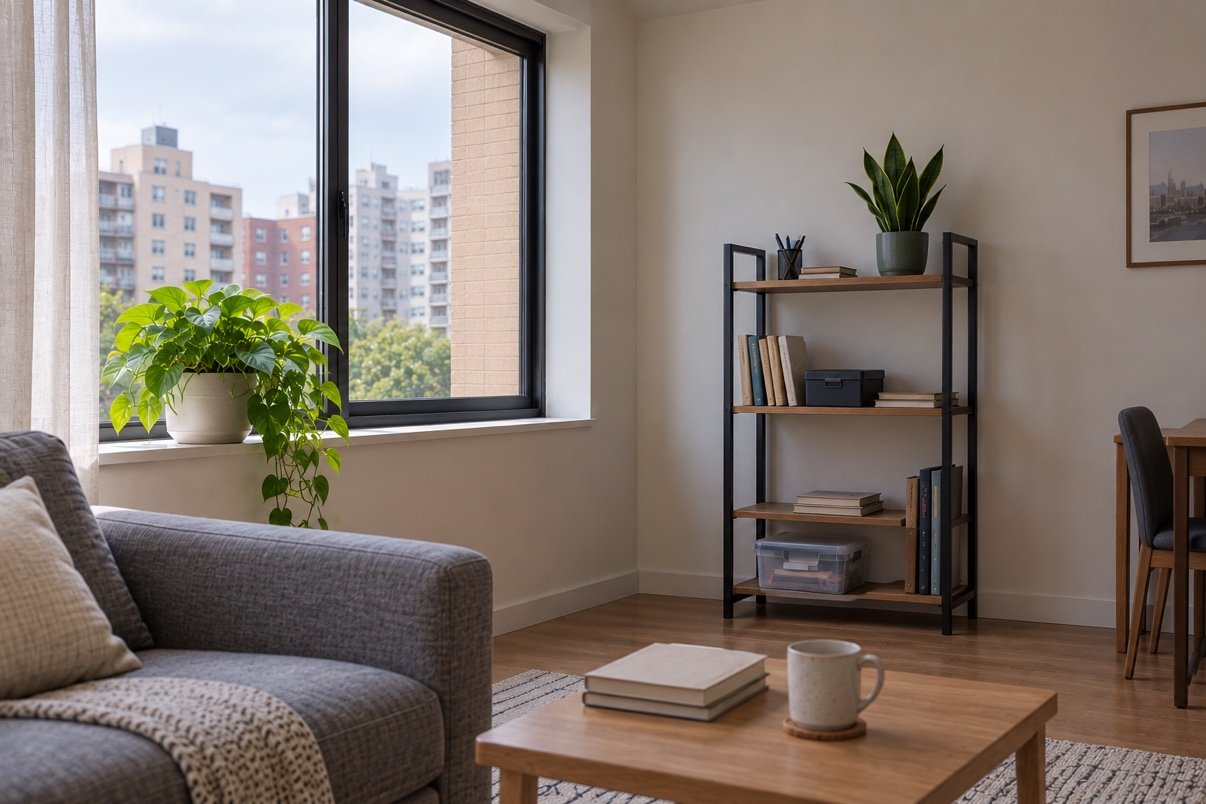
Your Room Can Look Bright and Still Be Too Dark for a Plant
Indoor light can be deceptive.
Even a well-lit indoor space receives much less light than an outdoor location, and the amount available to a plant can change significantly within the same room. A place that looks perfectly bright may provide much less useful light several feet away from the window.
This is why judging an entire room as “bright” or “dark” doesn’t tell you enough.
Instead, evaluate the exact place where the leaves will be.
That small shift in thinking can prevent you from choosing a plant for a location that was never a good match in the first place.
Start With the Exact Spot Where the Plant Will Live
Look at the shelf, wall, table or corner you want to use.
Where is it in relation to the nearest window?
A plant sitting directly beside a window is experiencing a different environment from one on a shelf across the room, even though both are technically in the same room.
This matters especially when you’re using vertical or overlooked space. A high shelf might solve your space problem but receive less light than the surface below it. A corner might be physically perfect but sit outside the strongest path of daylight.
Plants can respond in visible ways to where their light comes from. Years ago, David planted a bean seed and kept it in a shaded spot. As the seedling emerged, he noticed the young growth leaning toward the direction where sunlight was reaching it.
It was a simple observation, but it made the importance of light direction visible: the seedling wasn’t responding to how bright the room seemed. It was responding to where the available light was coming from.
If you’re still deciding where a plant could fit, our guide to where to put plants in a small apartment when you’re out of space can help you identify possible locations first.
Then come back to the light.
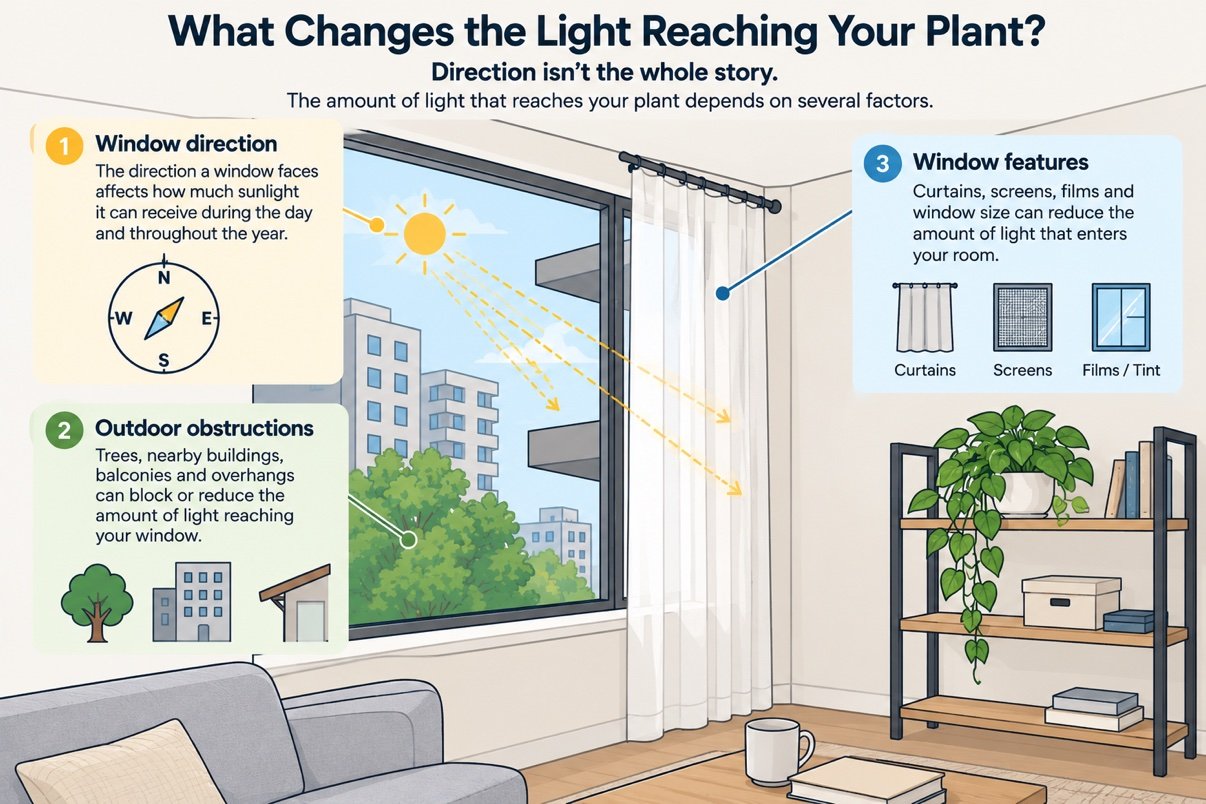
Window Direction Is a Starting Point, Not the Answer
Window direction gives you a useful first clue.
In the Northern Hemisphere, south-facing windows often have the potential for stronger light. East-facing windows commonly receive morning sun, while west-facing windows can receive stronger afternoon light. North-facing windows generally receive less direct sunlight.
But don’t turn those descriptions into rigid rules.
A south-facing window shaded by another building may provide less usable light than expected. A different window with a clearer view of the sky may perform very differently.
University Extension guidance also cautions that direction is only one of several factors determining how much light actually enters a window.
Use direction to begin the investigation, not to end it.
Look at What Stands Between the Plant and the Sky
Now look through the window.
Do you see open sky, or another building?
Are there trees outside? A balcony above the window? A deep roof overhang?
Then look at the window itself. Curtains, screens, films and tinting can all reduce the amount of light entering the room. Even the size and characteristics of the window matter.
This is why two apartments with the same window orientation can have very different growing conditions.
Don’t evaluate the compass direction alone.
Evaluate what the plant actually “sees.”
Distance From the Window Matters More Than It Looks
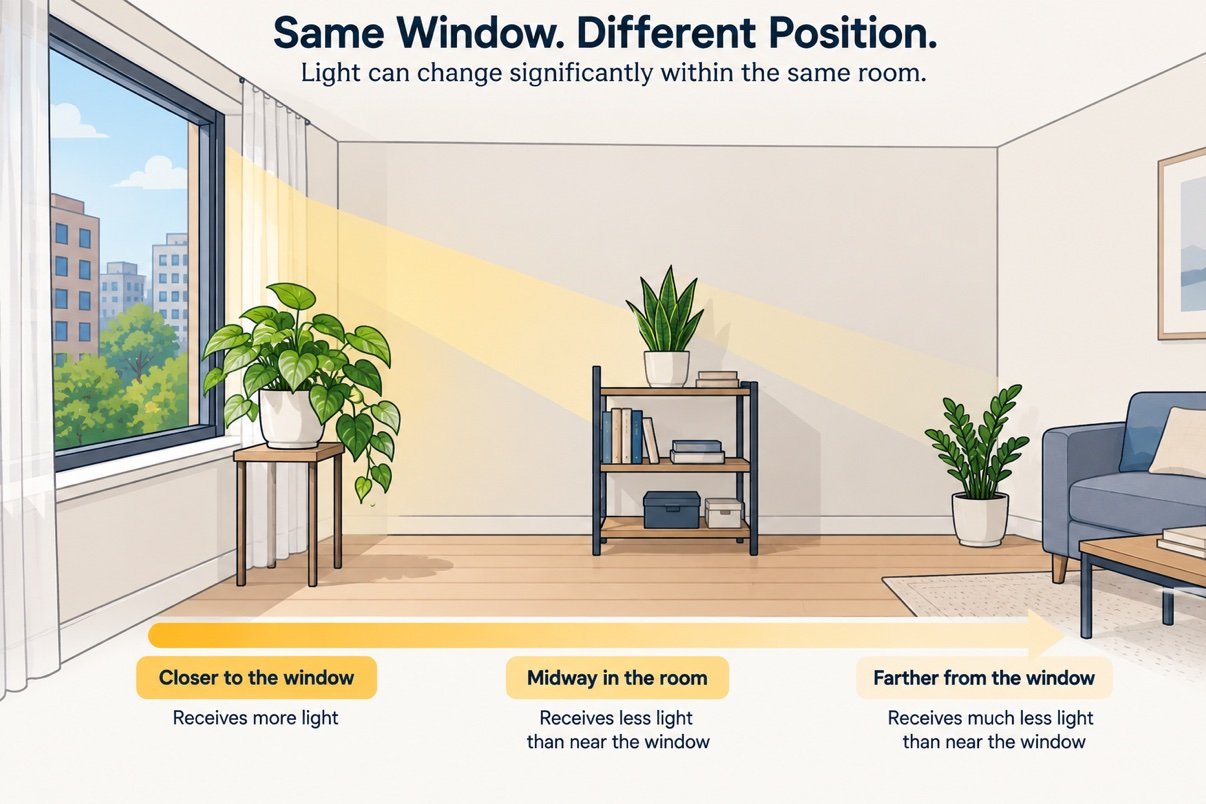
Moving away from a window isn’t just changing where the plant sits. You’re changing how much light reaches it.
Light levels indoors can drop quickly with distance from the window. Iowa State notes that areas more than a few feet from even bright windows can sometimes be too dim for successfully growing many houseplants, and areas just to the side of a window can be darker than they appear.
That doesn’t give us a universal rule such as “five feet is good” or “six feet is too far.”
There are too many other variables.
Instead, compare actual positions.
The same plant beside a window, on a shelf farther into the room and in a side corner may experience three very different light environments.
Same room. Same window. Different light.
What Does “Bright Indirect Light” Actually Mean?
You’ve probably seen this phrase on plant labels and care guides:
Bright indirect light.
It sounds precise until you try to find it in your apartment.
A useful practical description from Iowa State is light bright enough to cast a distinct shadow, but without direct sun rays hitting the foliage.
That gives you something more useful to look for than the words alone.
Direct light means sunlight is reaching the foliage directly. Bright indirect light is still bright, but the plant isn’t sitting in those direct rays.
Lower-light conditions have less intensity available.
The boundaries between categories aren’t perfectly universal, however. Different horticultural sources use different numerical ranges for low, medium and high indoor light. Maryland, Minnesota and Illinois, for example, publish different foot-candle guidelines.
So don’t treat “bright indirect” as one magic number.
Treat it as a description of the conditions you are trying to recognize.
Light Changes During the Day and Through the Year
A spot you check at 9 a.m. may look different at 3 p.m.
It can also change with the seasons. Sun angle, day length, leaves on outdoor trees and structural obstructions can change how much light enters a window over time.
You don’t need to monitor the room every hour.
Just avoid making your entire decision from one brief look.
The GreenSpaceAnywhere Light Check
Once you understand the variables, evaluating a possible plant location becomes much simpler.
Before choosing a plant, run the GreenSpaceAnywhere Light Check on the exact spot where you want it to live.
Use these six questions before deciding what belongs there.
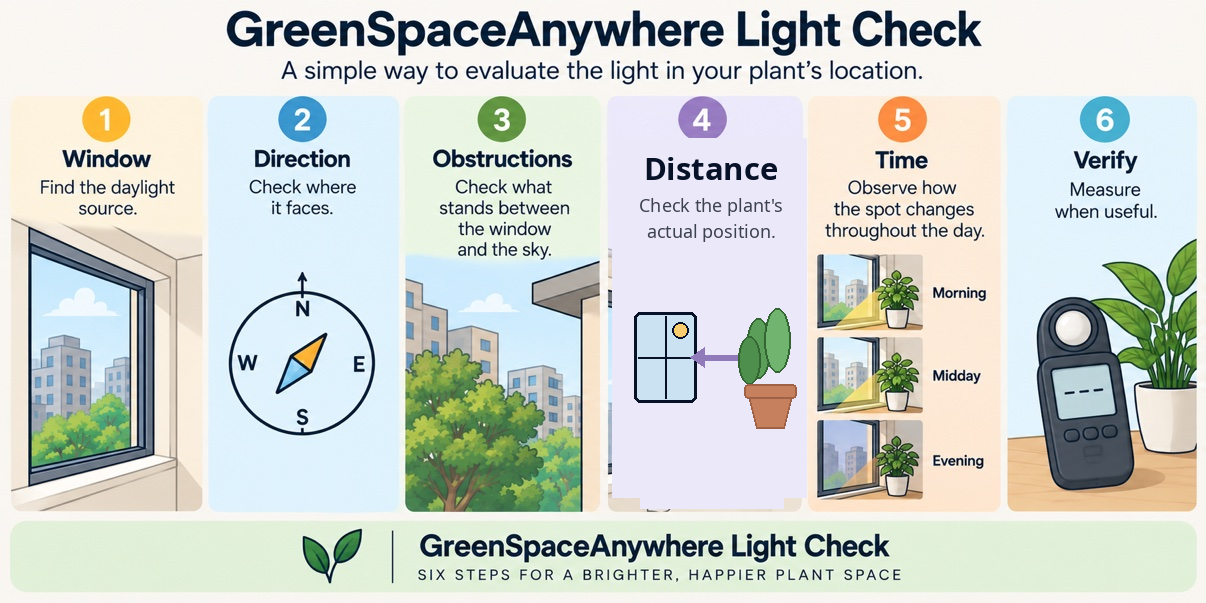
Window
Where is the natural light coming from?
Identify the window that provides most of the daylight to the spot you’re considering.
Direction
Which direction does that window face?
Use the orientation as your starting clue, not your final answer.
Obstructions
What is between the plant and the available daylight?
Check buildings, trees, overhangs, curtains, screens and other things that may block or filter the light.
Distance
Where will the leaves actually be in relation to the window?
Evaluate the plant’s position, not just the room.
Time
What happens to that spot during the day?
Check it at more than one time if you’re unsure, and remember that conditions can change with the seasons.
Verify
Put the clues together.
For many everyday decisions, careful observation gives you a useful starting point. If the situation is still unclear, measuring the light can add another piece of evidence.
A Quick Shadow Check Can Give You a Clue
A shadow can provide a simple visual clue.
If the location is bright enough to produce a clearly distinguishable shadow without direct sunlight hitting the leaves, that is consistent with Iowa State’s practical description of bright indirect light.
But don’t turn the shadow into a precision instrument.
It is a clue, not a measurement of exactly how much light your plant receives.
When You Want More Precision, Measure the Light
If you’re unsure about a location, light intensity can be measured.
You may encounter foot-candles or lux when researching indoor plant light. A light meter or other measuring tool can help you compare locations more objectively.
The important part is not chasing one supposedly perfect number. Published horticultural guidelines don’t all draw the boundaries between low, medium and high light in exactly the same places.
Use measurements as additional information, not as a replacement for understanding the space.
Watch What the Plant Tells You Over Time
Your initial light check gives you a starting point. The plant’s growth can give you more information later.
Insufficient light can be associated with pale growth, long thin or “leggy” stems, greater spacing between leaves, leaf drop, reduced variegation and poor flowering in plants grown for flowers. Too much light can also cause problems, including scorched or bleached foliage.
David also remembers one of his mother’s ornamental plants. Its leaves were normally deep green, but after it was moved into a kitchen with less natural light, the leaves became noticeably lighter. We can’t say from that observation alone that low light caused the color change, but it was a useful reminder that changes in a plant can sometimes follow changes in where it lives.
But be careful with diagnosis.
A yellow or pale leaf doesn’t automatically mean “not enough light.” Plant problems can have multiple causes.
Look for patterns, consider the conditions and make adjustments rather than relying on a single leaf as your answer.
What If the Spot Doesn’t Get Enough Light?
Finding that a location is too dim doesn’t mean you have to give up on having a plant there.
It means you now have information.
You might move the plant closer to usable natural light. You might choose another location. You might choose a plant whose light needs are a better match for the conditions you actually have.
And when natural light genuinely isn’t enough for what you want to grow, supplemental lighting is another option. University Extension guidance supports using supplemental light when available natural light doesn’t meet a plant’s needs.
Choosing the right low-light plant and deciding whether you need a grow light are separate decisions, so we’ll treat those as their own guides rather than trying to solve everything here.
Check the Light Before You Choose the Plant
The goal isn’t to find a perfect apartment.
It’s to understand the space you already have.
Look at the window. Notice what blocks the light. Check the distance. See how the location changes through the day. Measure when you need more information.
Then choose what can grow there.
Once you understand the light in that spot, the next step is choosing the right plant for your space.
At GreenSpaceAnywhere, we think about small-space growing in this order:
Space → Light → Solution → Placement → Plant
Sometimes the place you wanted won’t be right for the plant you had in mind. That’s useful information, not a failed space.
There may still be a plant, a different position or another solution that can bring that part of your home to life.