If you think your kitchen is too small for plants, you are probably looking for space in the wrong place.
Look at a kitchen like the one in the photo.
There is no big island.
No huge countertop waiting to be decorated.
No spare room.
And yet, there are plants.
The reason is simple:
Not all the space in a kitchen is at counter level.
There are walls. There are shelves. There is space above the cabinets. There are corners we usually ignore.
When horizontal space runs out, look up.
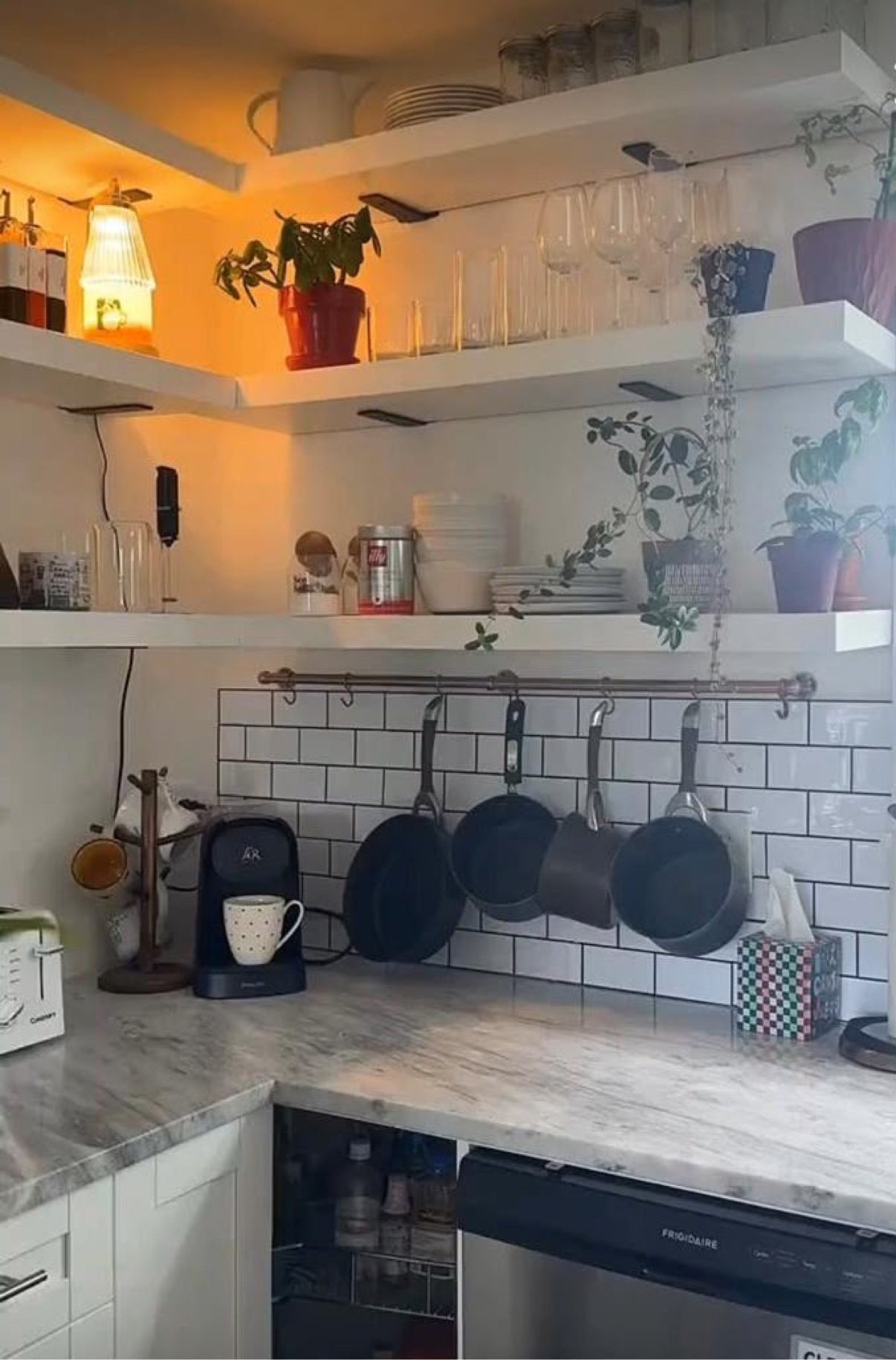
The space you already have and are not using
A small kitchen almost never has much horizontal space available.
The counter has work to do. That is where you prep food, place the coffee, leave the dishes, or simply need room to move.
So putting a big plant on it is probably not the best solution.
But look up.
A floating shelf.
The top of a cabinet.
A hook near a window.
A small pot sharing space with your glasses.
These are spaces that already exist.
And they can become the perfect place for a plant without taking away the space you really need for cooking.
You do not need to find new space. You need to start using the space you already have in a different way.
Before choosing the plant, look at the light
Here is something important that we often forget:
a kitchen is not automatically a good place for just any plant.
Although kitchens tend to be more humid than other rooms, conditions can vary a lot. A kitchen with a bright window is completely different from an interior kitchen with little light.
So before buying a plant, look at where the light is during the day.
If you are not sure whether a shelf or corner gets enough light, check the light in that exact spot.
Is there a window?
Is the light bright but indirect?
Is the spot fairly dark?
Would the plant sit right next to the stove or another heat source?
Placement matters.
Even plants considered easy need the right conditions to grow. Pothos and snake plant show up on nearly every list of plants that tolerate low light, while monstera does better with medium, brighter light.
And there is a simple rule:
Do not place a plant directly on or next to an intense heat source.
Excessive heat and strong temperature swings can damage the leaves.
Which plants work well in a small kitchen?
There is no single “kitchen plant.”
The best choice depends on the light you have and where you want to put it.
But these options can work especially well in small spaces.
Pothos
If you want to start with an easy foliage plant to integrate into a kitchen, pothos is an interesting option.
It tolerates low light better than many houseplants, and its growth works very well on shelves, where its stems can trail down.
That makes it a good option for using vertical space.
Best for: shelves and spots where you want the plant to hang down.
If you are new to plants, start with the forgiving ones. Read: You Don’t Need a Green Thumb. You Need the Right Plant.
Snake plant (Sansevieria)
If your kitchen has low light and you want a plant that takes up little horizontal space, the snake plant can be a good candidate.
It is among the plants that tolerate low-light conditions.
Its vertical growth also means you can place it in a corner without turning it into an obstacle.
Best for: corners, narrow spaces, and the tops of cabinets.
Monstera
Monstera is different.
Its large leaves can become the focal point of a room, but it needs more light than plants like pothos or snake plant. It does best in a medium-light spot.
If you have a kitchen with a good window, it can be a way to get a lot of impact with a single plant.
Best for: near a window with good light.
String of hearts
If you want to use a high shelf, a trailing plant can be even more interesting.
The string of hearts (Ceropegia linearis subsp. woodii) has long trailing stems, so it works especially well on high shelves and tall furniture. The RHS lists it as a plant for a bright spot, so give it good light and let its stems fall freely.
Best for: high shelves where you can let its stems fall freely.
What about herbs like basil?
Here is another interesting possibility.
If you have a window with plenty of light, you can turn part of your kitchen into a small herb garden.
Basil, for example, needs a lot of light. Most growing guides put it at six or more hours of bright light a day, so it works better next to a bright window than in a dark corner.
And it has an advantage an ornamental plant does not have:
you can cook with it.
A small pot of basil can be decoration and part of your kitchen at the same time.
Three places to put plants without losing workspace
Now comes the fun part.
You do not need to reorganize the whole kitchen.
Start by looking at these three places.
1. On top of the tall cabinets
Is there space between your cabinets and the ceiling?
That space usually goes completely unnoticed.
A plant placed there can visually fill an empty area without taking up counter space.
Just check first that the spot has enough light for the plant you choose and that you can easily reach it to water and care for it.
Do not turn a plant into decoration you can never reach.
2. A floating shelf
A shelf does not have to become a full garden.
It can simply be a small surface where the things you already have live together.
Some glasses.
A mug.
A jar.
And a plant.
Like in the photo that inspired this article.
You do not need to separate plants from the rest of your life.
You can integrate them into it.
This is where my three-level shelf garden started.
3. A hook near a window
If you have a window but no space on the sill, look to the sides and up.
A hook can let you hang a pot without taking up counter space.
A hanging plant can also draw the eye upward and make a small kitchen feel more vertical.
Just make sure the support is properly installed and can hold the weight of the pot, especially after watering.
That idea doesn’t stop at the kitchen. Shelves, furniture, walls, hanging space and overlooked corners can reveal growing space throughout a small home. You can find more places for plants when you’re out of floor space.
Start with a single plant
This is where we want to go back to the beginning.
You do not need to redesign your kitchen.
You do not need to buy ten plants.
You do not need to become an expert.
You just need one spot and one plant.
Find a shelf.
Look at a corner.
Notice the space above your cabinets.
Find a window.
And then choose a plant that can truly live in those conditions.
Not the other way around.
First the space. Then the plant.
This week’s challenge
Do something very simple.
Put one living thing in your kitchen.
A pothos on a shelf.
A snake plant in a corner.
A string of hearts in a high spot.
Or basil next to a bright window.
Just one.
Then look at your kitchen again.
Does it feel different?
You might discover you never needed more space after all.
Maybe you just needed to look up.
Because sometimes you do not need to change an entire room.
You just need to give it a little life.
And maybe your kitchen was never too small.
You were just looking in the wrong direction.
Pingback: One Corner, Three Levels of Green: A Small-Space Shelf Garden That Works